


The sales tax contributed around one-third of the total federal tax receipts in 2024-25. More than 26% growth recorded in sales tax revenue in 2024-25 was due to policy as well as enforcement measures. The introduction of digital invoicing (e-invoicing) for businesses in the sales tax system is an important policy intervention aiming to improve compliance for optimizing sales tax collection because of the following benefits:
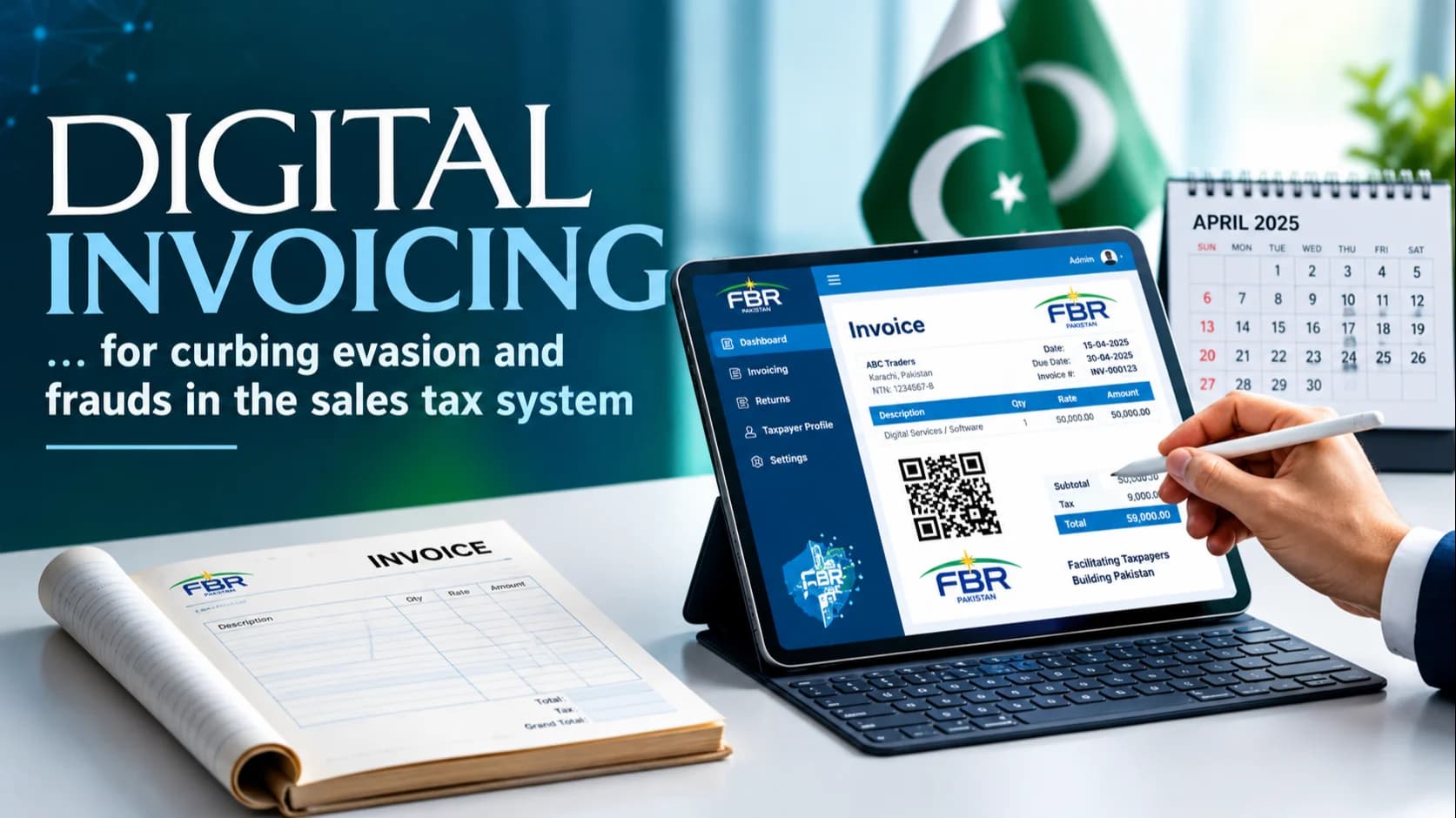
Digital invoicing enables real-time reporting of taxable supplies, making it impossible for businesses to evade sales tax by underreporting such supplies.
The use of digital signatures, unique invoice numbers and QR codes enhances invoice authenticity and traceability, making it impossible for businesses to inflate input tax on the strength of fake and flying invoices for suppressing sales tax liability.
Digital invoices can be issued and shared instantly; therefore, digital invoicing accelerates business processes and reduces administrative workload.
Digital invoicing initiative ensures secure storage of invoice data for long periods; thus, facilitating audits and dispute resolution between tax authorities and sales taxpayers.
Digital invoicing supports tax filings, more accurate tax calculation and easier and safer storage because of QR code.
Digital invoicing has become mandatory in many jurisdictions, including Pakistan, where the FBR requires businesses to follow electronic invoicing rules to streamline tax compliance and reporting. The FBR has mandated electronic invoicing for corporate and non-corporate registered persons with phased integration deadlines, requiring all taxable supplies and services to be invoiced electronically and reported in real time.
Digital Invoicing Rules
The FBR has developed the necessary framework for digital invoicing to safeguard sales tax revenue and to ensure a level playing field for businesses in the sales tax system. The FBR has notified the following rules for all sales tax registered persons:
SRO 69(I)/2025, issued on 29 January 2025, amending the Sales Tax Rules, 2006, to enforce mandatory electronic sales tax invoicing for all the corporate registered and non-corporate registered persons. It provides that all registered persons are required to integrate hardware and software for e-invoice generation and transmission through licensed integrators;
SRO 1413(I)/2025, issued on 1 August 2025, specifies deadlines for e-invoicing integration based on category and turnover from sales tax returns over the last 12 months of the sales tax registered persons as under:
o All public companies and other companies with annual turnover exceeding PKR 1 billion and all importers by 1 September 2025.
o All companies with annual turnover between PKR 100 million and PKR 1 billion by 1 October 2025.
o All individuals and associations of persons (AOPs) with annual turnover exceeding PKR 100 million by 1 October 2025.
o All companies with annual turnover less than PKR 100 million by 1 November 2025.
o All other registered persons by 1 December 2025.
To issue e-invoices, the sales tax registered persons have to ensure:
Integration of accounting, invoicing and point of sale (POS) systems with FBR's e-invoicing platform for real-time transmission of invoices;
Issuance of e-invoices with digital signatures, unique invoice numbers and QR codes;
Immediate reporting and electronic archiving of invoices for at least six years;
Use of FBR-approved software or hardware, including fiscal integration devices;
Registration with FBR and successful system testing before mandatory start dates.
Impact on Revenue
Historically, Pakistan has been facing significant revenue shortfalls, resulting in large annual fiscal deficits. For instance, the FBR's revenue shortfall from July to December 2025 is around PKR 331 billion, mainly due to less than potential domestic sales tax collection. There is a significant sales tax gap estimated to be PKR 3.6 trillion, largely in the retail sector (PKR 310 billion), textile sector (PKR 814 billion), petroleum and food products (PKR 384 billion), chemicals and fertilizers (PKR 326 billion), iron and steel (PKR 200 billion), electronics (PKR 139 billion), beverages (PKR 101 billion) and sugar (PKR 46 billion). The tax authorities have initiated criminal prosecution under sections 37A and 37B of the Sales Tax Act, 1990, for the alleged offence of tax fraud against sales tax registered persons being beneficiaries and other persons being abettors and connivers (the fraudsters). Such fraudsters were involved in the issuance of fake sales tax invoices for the purposes of generating inadmissible input tax adjustments, resulting in a massive loss of revenue. The tax authorities documented these allegations of tax fraud in the First Information Reports (FIRs) registered against fraudsters.
As the digital invoicing initiative has produced measurable gains in VAT/sales tax revenue in other countries, there is a strong likelihood that enforcing digital invoicing in all sectors of the economy in Pakistan would improve sales tax revenue through different channels.
Digital invoicing has the potential to curb tax evasion and tax frauds committed to understate or underpay the tax liability or overstate the entitlement to tax credit or tax refund, resulting in loss of tax revenue by way of:
suppressing or underreporting taxable supplies;
claiming inadmissible input tax credit;
making taxable supplies of goods without issuing tax invoices;
issuing tax invoices without supply of goods;
collecting tax but not depositing it into the government exchequer;
tampering with or destroying documents to be maintained; and
making taxable supplies without getting sales tax registration.
Under the digital invoicing initiative, automated matching of supplier and buyer invoices would help to detect mismatches, fake purchases and inflated input tax claims, which would lead either to voluntary correction or to additional assessments. Moreover, when businesses know that every invoice is visible to the FBR, the perceived risk of detection rises, which typically enhances voluntary compliance and reported supplies upward. This is also true because by documenting the supply chain more completely, misreporting or underreporting of turnover is prevented. As the digital invoicing would improve documentation of the economy by bringing more and more businesses and transactions into the formal tax net, it would expand the sales tax base over time and would result in sustainable growth in sales tax collections. Last but not least, the digital invoicing would reduce tax authorities' burden in terms of costs incurred on registration of FIRs against tax fraudsters and subsequent cumbersome and stretched prosecution.
However, implementing digital invoicing requires investment in compatible ERP or accounting software and sometimes hardware upgrades. This cost can be burdensome, especially for small and medium-sized enterprises (SMEs) without existing robust IT infrastructure. Businesses would face challenges understanding compliance requirements and adapting quickly to updates in mandates and procedures.
Conclusion
The traditional sales tax enforcement measures, such as cross-matching, audit and recovery, have failed to curb sales tax evasion in developing countries like Pakistan. Therefore, a risk-based real-time enforcement system is effective and is recommended in many empirical studies. The digital invoicing initiative in Pakistan is a substantive measure to modernize the sales tax system. Commencing in 2025, it ensures real-time, transparent reporting of sales transactions, which significantly reduces tax evasion and tax fraud. This would result in enhanced revenue collection for the government while enhancing audit efficiency and compliance accuracy as well.
Although the transition adds complexity through system integration, legal compliance demands, and operational changes, the long-term benefits include improved business efficiency, reduced risk of penalties, and strengthened trust with customers. Digital invoicing is also crucial for creating a transparent and documented economy.
The writer studied Taxation Policy & Management at Keio University, Japan, and is serving as Additional Commissioner (Inland Revenue), Corporate Tax Office, Lahore.
