
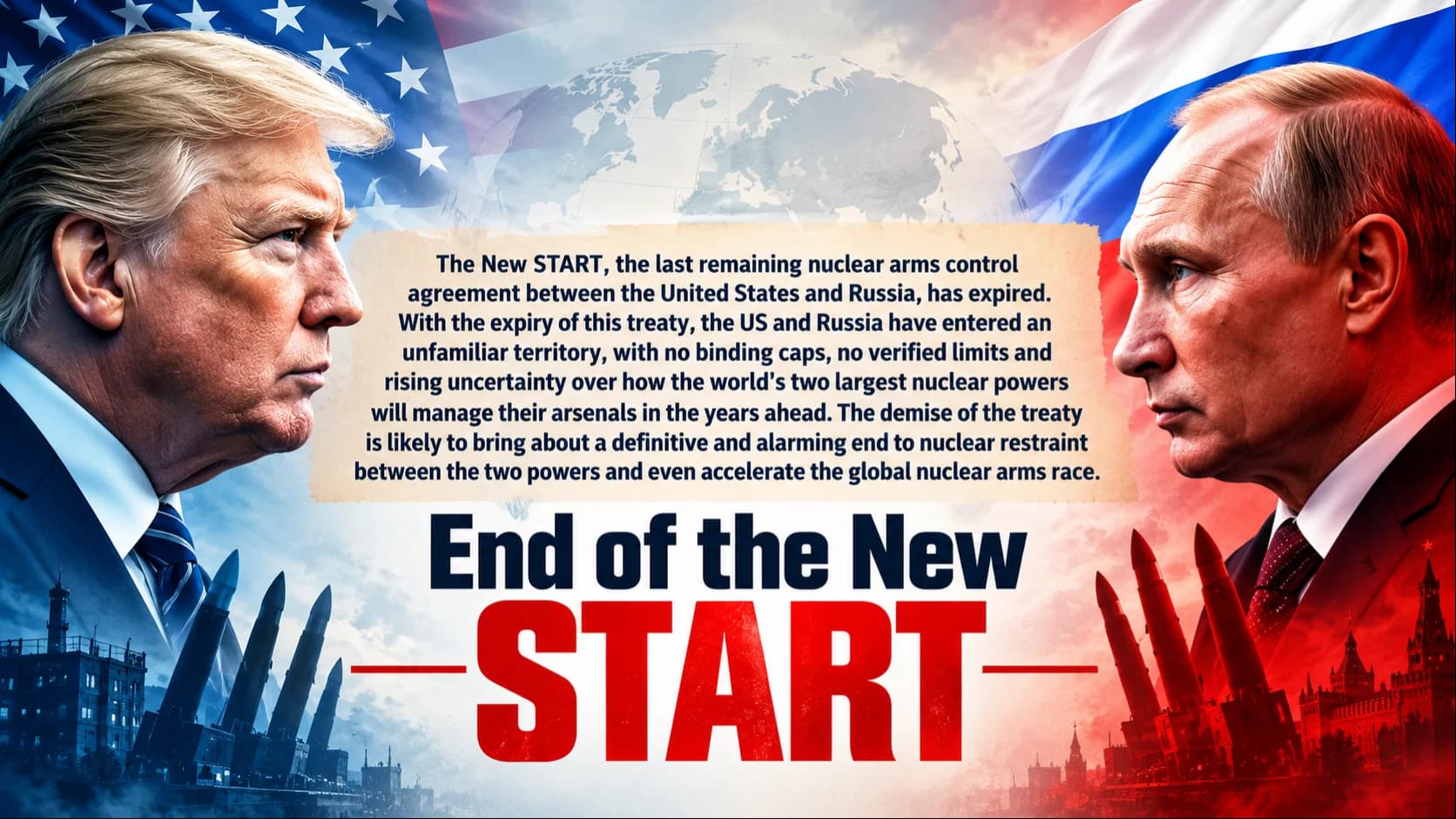
The Strategic Arms Reduction Treaty, also known as 'New START,' has expired, without a successor. The expiry of this last nuclear weapons control treaty between the United States and Russia, which was signed in 2010, marks a grave moment for international peace and security, as it effectively puts an end to the arms control cooperation between Washington and Moscow that helped bring an end to the Cold War.
Introduction
On Feb. 5, 2026, the world entered a critical phase in more than half a century, as the treaty that limited the United States and Russia to 1,550 deployed strategic nuclear warheads on 700 deployed nuclear delivery systems (airplanes, intercontinental ballistic missiles and submarine-launched missiles) and to 800 deployed and non-deployed nuclear launchers of those missiles and airplanes that can launch nuclear weapons, expired. With the expiry of the New Strategic Arms Reduction Treaty (New START), we face a world without any binding limits on the strategic nuclear arsenals of Russia and the United States – the two states that possess the overwhelming majority of the global stockpile of nuclear weapons.
What is New START?
The New START, or Prague Treaty, was signed by then-US President Barack Obama and his Russian counterpart, Dmitry Medvedev, in Prague on April 8, 2010, and entered into force the following year.
The original START-I was signed between the US and USSR in 1991 and came into force in 1994.
There is no agreed definition of what constitutes a “strategic” or “non-strategic” nuclear weapon, but the treaty defines strategic nuclear weapons systems as those that are “intercontinental in range”, i.e. that can be launched from Europe and detonated in the United States and vice versa.
The treaty was designed to curb the most destructive category of nuclear weapons: long-range strategic arms capable of striking major political, military and industrial targets.
Background
During the Cold War, the nuclear arms race was one of the most frightening aspects of superpower rivalry, spreading fears worldwide.
At the end of the Cold War, as a sign of de-escalation, Washington and Moscow showed mutual willingness to reduce their nuclear arsenals, signing several treaties to regulate their nuclear activities.
Most prominent of them was the START I, which was signed in 1991 and entered into force three years later, remaining in force for 15 years.
A comparable situation arose when START I expired in December 2009, following then-Republican President George W. Bush's decision not to pursue a new agreement with Russia.
But under President Barack Obama, this brief interlude culminated in the signing of the New START in 2010 between the US and Russia.
Key Provisions
The New START superseded a 2002 treaty that obligated Russia and the US to reduce their operationally deployed, strategic nuclear warheads to between 1,700 and 2,200 by the end of 2012.
It called for further reductions on long-range nuclear weapons and provided greater specificity about different types of launchers. The new limits were:
700 deployed intercontinental and submarine-launched ballistic missiles (together with heavy bombers)
1,550 nuclear warheads deployed on those platforms, and
800 launchers (both deployed and non-deployed).
These reductions were achieved by February 5, 2018.
The treaty included mechanisms for compliance and verification, which have worked effectively.
It provided for twice-yearly exchanges of data and ongoing mutual notification about the movement of strategic nuclear forces, which, in practice, occurred on a nearly daily basis.
Importantly, the treaty also mandated short-notice, on-site inspections of missiles, warheads and launchers covered by the treaty, providing valuable and stabilizing insights into the other's nuclear deployments.
Lastly, the treaty established a bilateral consultative commission and clear procedures to resolve questions or disputes.
Extension and Suspension
The New START expired in 2021; however, the Biden administration agreed to extend it for a five-year period, i.e. till 2026.
Although the treaty expired on Feb. 6, 2026, Russia had suspended participation in 2023 amid the Ukraine war, leading both sides to halt inspections and data sharing.
Negotiations for a post–New START framework stalled in 2024–25, with mutual distrust and disagreement over scope and terms.
President Trump himself shrugged off the terrifying prospect of a world without nuclear limits after the expiry of this treaty.
In January, he told the New York Times: “If it expires, it expires… We'll just do a better agreement”.
The treaty was not extended another time because its original text says it can only be extended once, and this has already happened - in 2021.
Global Implications
The expiry of the treaty will be a death knell for more than five decades of arms control at a time of surging global instability, contributing to a general collapse of the rules-based international order established after the Second World War.
Dmitry Medvedev, who signed the New START deal with Barack Obama in 2010 as the Russian president, said the treaty's expiry should “alarm everyone”.
Obama wrote on social media that the expiry of the treaty “would pointlessly wipe out decades of diplomacy, and could spark another arms race that makes the world less safe”.
Currently, both the US and Russia are developing new types of delivery systems that fall outside older arms-control categories.
These innovations can create the illusion that one side might gain an advantage, weakening deterrence and encouraging the belief that crises can be managed or exploited.
When one state takes steps to increase its security, others often feel less secure and respond in ways that leave everyone worse off.
Without the New START limits, strategic planning on both sides is more likely to be driven by uncertainty and worst-case assessments. That increases the risk of a new arms race, especially if either side begins uploading additional warheads onto existing missiles or expanding delivery systems.
Even if large-scale build-ups do not occur immediately, the absence of limits and transparency will make intentions harder to read and crises harder to manage.
If Washington and Moscow refuse to limit their nuclear arsenals, European countries will be forced to limit their dependence on Washington.
This situation will necessitate a debate on Europe's creating its own nuclear umbrella (through France and the United Kingdom).
The re-emergence of unconstrained competition between the two largest nuclear powers indirectly heightens Chinese threat perceptions, creating a classic security dilemma.
Although China's nuclear arsenal remains significantly smaller and its leadership continues to emphasize an independent nuclear posture, sustained US-Russia upload races and renewed emphasis on MIRVs and missile defence will inevitably shape Beijing's strategic calculations.
Over time, this development risks drawing China more deeply into a three-way nuclear dynamic it has historically sought to avoid, further complicating prospects for future arms control.
A Call for Caution
New START was never a comprehensive solution to US-Russia strategic rivalry, and parts of its framework reflect an earlier phase of nuclear competition. But it has provided a foundation of predictability in a deteriorating relationship. Allowing it to expire would remove that foundation.
In the current geopolitical climate, the margin for error is already small. Preserving some form of mutual restraint – however limited – remains preferable to risking the dangerous instability of unconstrained nuclear competition.
Conclusion
The expiry of New START is a reminder of the fragility of global nuclear restraint. The international community has an opportunity to push for inclusive, multilateral disarmament talks rather than sliding into a new arms race. A genuine 'fresh start' will require leadership from the principal nuclear powers and sustained global pressure to ensure that nuclear weapons do not continue to define the future of international security.
The writer is a member of staff.