

More than half a million Pakistanis graduate every year with at least a two-year college degree. A little more than 11% of 30-year-olds in Pakistan have at least a two-year college degree and, judging by the fact that the number of graduates is growing at three times the population growth rate, that number will likely keep on rising for every subsequent generation of 30-year-olds in the country. However, our education system has failed to keep pace with emerging market trends. It means that although Pakistan has a lot of raw talent, it is not prepared for the rapid advancement of technology that will necessitate a much better trained workforce than the one we have now.
Where we currently stand
About 8.6% of Pakistanis over the age of 25 have at least a bachelor's or higher degree, according to data from the World Bank for the year 2021, the latest year for which comparable data was available. But as we stated at the outset, that number hides the fact that younger Pakistanis are going to college at higher rates than their parents and grandparents, and that this increase in rate is itself increasing.
The number of people in Pakistan who successfully finished a college degree in the academic year ending in 2022 was about 502,000 students, according to data from the Higher Education Commission of Pakistan. That number represents an average annual growth rate of 7.3% per year over the five years between 2017 and 2022. To put that growth in context, it is more than three times higher than the 2.1% per year population growth rate during that same period.
One way to place this rise of higher education in Pakistan is that almost the same percentage of Pakistanis is college-educated today as was literate at Partition in 1947.
Is it good enough?
Although Pakistan is, indubitably, doing better than its own atrocious past, how well is it doing well enough for its emerging economic needs?
Pakistan has a sufficient number of college graduates to meet its own needs at this stage of its economic development and continue to improve further. Given the relatively light levels of industrialization, Pakistan barely needs more than it currently has in terms of a white-collar workforce with college degrees. Indeed, Pakistan can probably afford to export some of its talent, as it has been doing for the past four decades, given how much of it we produce relative to how much we need.
An irrefutable piece of evidence to prove that Pakistan has a surplus of educated young people is that salaries are almost stagnant. It means employers have no trouble finding enough people to fill all jobs that require a college degree, and it is so easy for them that they do not need to offer very high wages to do so.
Over the next 25 years, however, one hopes that Pakistan will move further up the value chain, and start doing more complex manufacturing and services. But given how rapidly Pakistan's higher education sector has been growing, if the current rate of growth is extrapolated into the future, it would imply that the proportion of young Pakistanis with college degrees would rise to about 56% by 2050.
For context, the United States has a college graduation rate of 46% among its adults between the ages of 25 and 34 – its more educated cohort. The equivalent number in China is 27%, which is probably a more realistic target for Pakistan to hit over the next quarter century. To hit that number by 2050, the increase in the annual number of college graduates in Pakistan could slow down from its current 7.3% per year growth rate to 4.6% per year growth and we would still hit the college graduation rate that China has today.
Our current baseline may be bad, but it covers our current needs, and the pace of growth is so rapid that it is likely to more than meet the needs of a fully industrialized economy within the next 25 years, even if the current rate of growth slows down somewhat, which it most likely will.
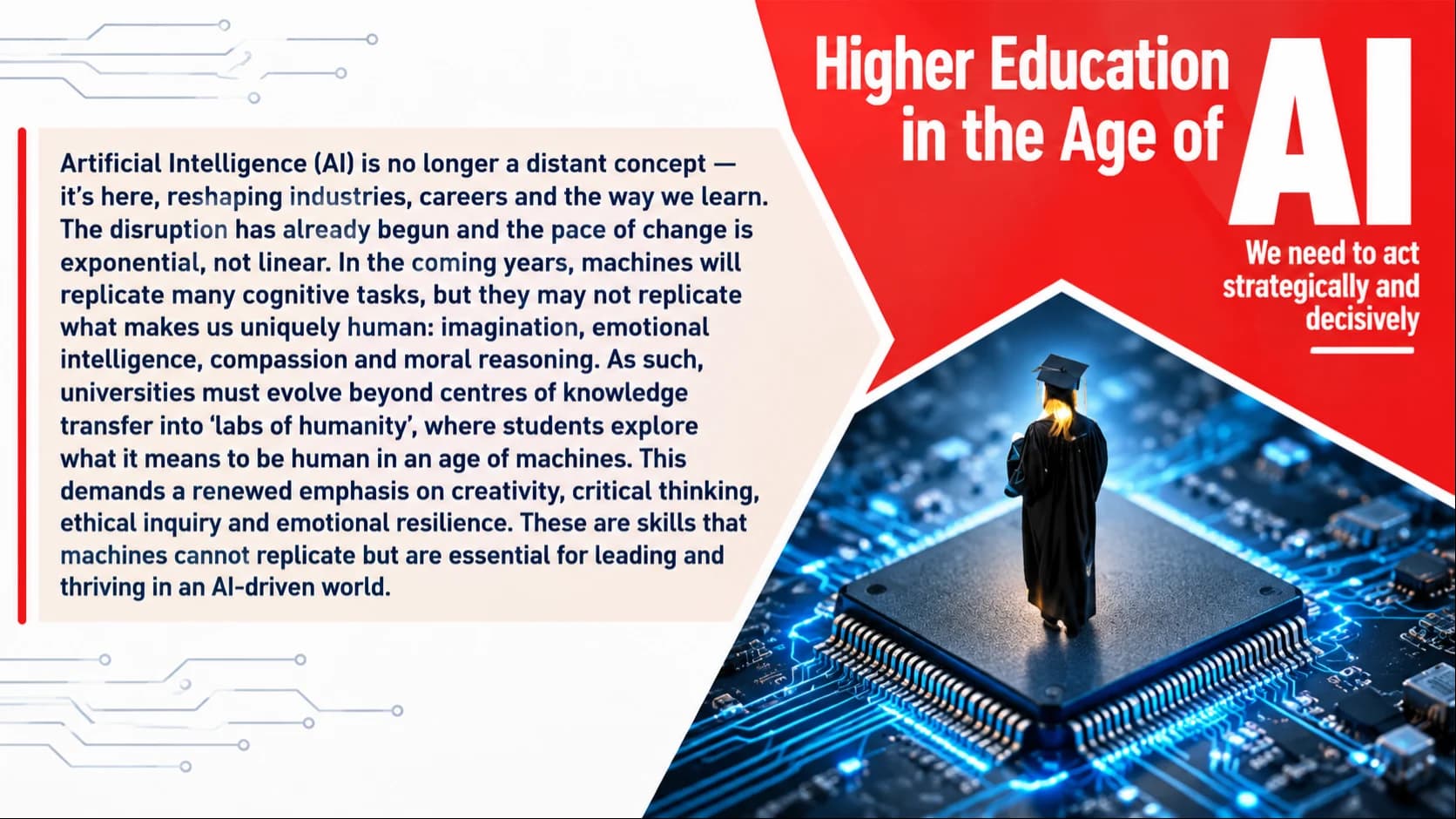
Al and the future of higher education
There is an emerging consensus that AI is likely to be bad for the country's nascent IT-enabled services export industry, both for freelancers and for companies. And as AI becomes a more widely used technology, Pakistan's low-quality human capital will find itself at a disadvantage in the global talent marketplace. This view seems problematic, or more candidly, flawed. The mistake being made by most people who assume that AI will be bad for economies like Pakistan is to make the following set of assumptions:
1. AI will transform how the world works.
2. The people who work in AI today have far higher levels of intelligence and human capital than all but the tiniest sliver of Pakistan's current workforce.
3. Therefore, Pakistan's current workforce cannot survive in the era of AI.
The first two statements are true but the third one seems an illogical conclusion of those. Here is the fundamental flaw in this thinking: it assumes that the base layer of AI is how AI will interact with the economy. Nothing could be further from the truth.
People are looking at ChatGPT, Perplexity, Claude, etc. and assuming that the level of intelligence required to survive in the AI age is the level required to create those programs. This is just like believing that every electrician in the world has to be like Nikola Tesla who demonstrated his alternating current light bulb in Manhattan in the 1880s.
Conclusion
Pakistan may have few college graduates now, but their number is rising rapidly. Pakistan's college graduates may not be as high quality as their counterparts in other countries, but AI now means that the quality differential will be lessened, and the price difference, ever in the Pakistani graduates' favour will become the dominant effect. Higher education in Pakistan is not good. But it might just be good enough, especially in the age of AI.
The writer is a Karachi-based academic.
Pakistan's Moment to Leap
Artificial intelligence offers Pakistan a rare opportunity to leapfrog traditional stages of development—if pursued strategically rather than symbolically. The prime minister's announcement of a $1 billion AI investment signals an ambition to position Pakistan as an active participant in the technological future. Today, AI is no longer confined to the tech sector; it is directly linked to economic strength, competitiveness, and geopolitical influence. Nations capable of building and governing AI systems will shape industries and global narratives, while others risk economic and strategic marginalization.
A key highlight of the initiative is its focus on capacity building, particularly the goal of training one million non-IT professionals. This marks a shift from limiting innovation to specialists and instead embedding AI across sectors. The emphasis on practical application over hype reflects a meaningful approach to digital transformation. From optimizing textile supply chains and enabling precision agriculture in Punjab and Sindh to expanding financial inclusion through smarter banking tools, AI holds tangible benefits.
Integrating AI into the national curriculum could also democratize opportunity beyond major urban centers. However, ambition must be matched with execution. Effective governance frameworks, diaspora engagement, startup support and equitable access will determine success. Ultimately, AI must become a national project—uniting government, private sector, academia and youth—before this strategic window closes.