
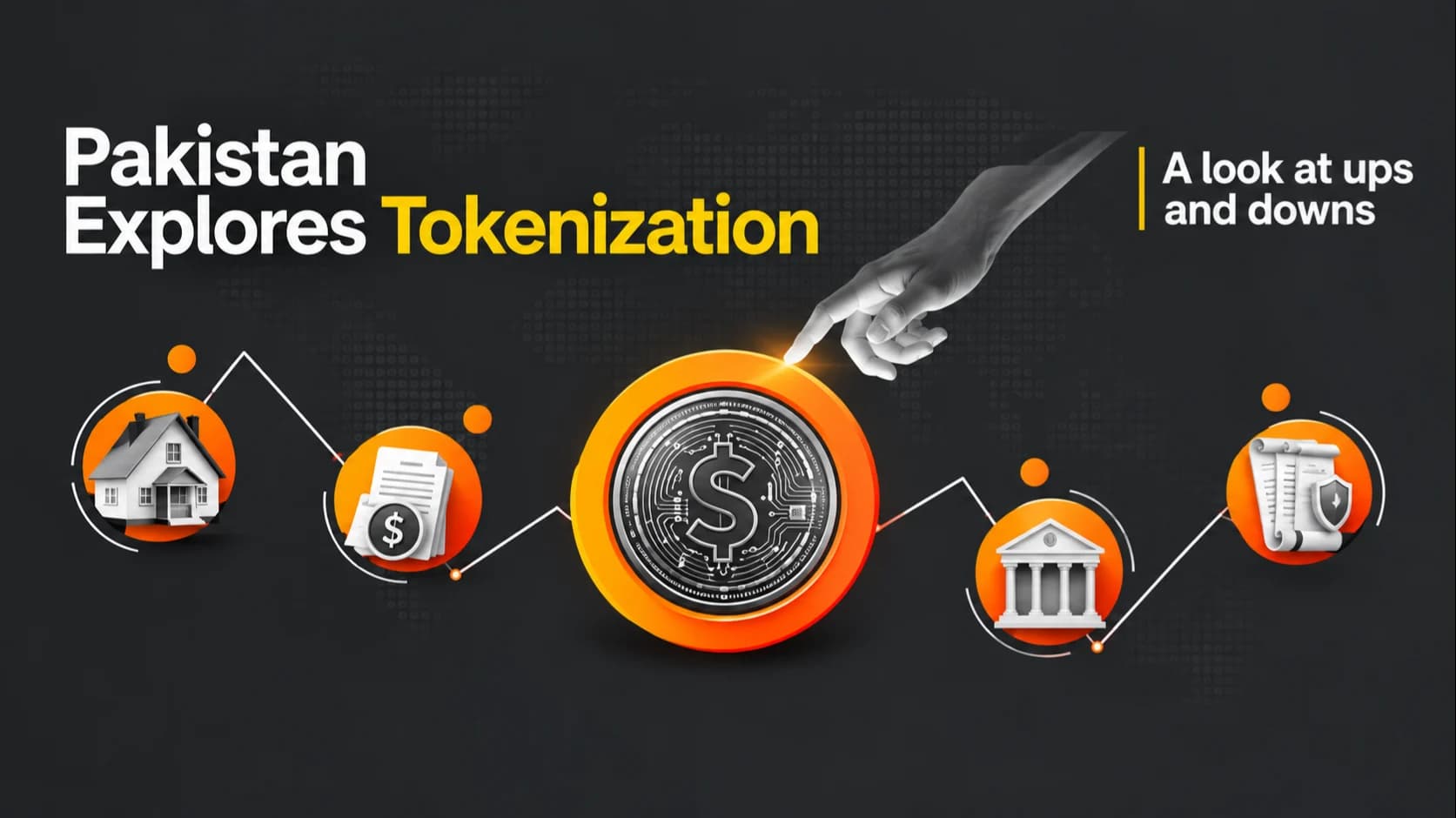



Pakistan has, in recent months, stepped up discussions around digital assets and financial innovation, including the creation of regulatory frameworks to better understand cryptocurrencies, blockchain applications and tokenized financial products. As a next step in this journey, Pakistan is preparing to enter the digital finance space by planning to tokenize a portion of its domestic government debt, aiming to attract a wider pool of investors and modernize the country's public debt market. Already, Pakistan's Finance Ministry has signed a non-binding memorandum of understanding with the global crypto giant Binance for consultations on the tokenization of sovereign bonds, treasury bills, and commodity reserves valued up to $2 billion. Adviser to the Finance Minister Khurran Schehzad, said that the Ministry of Finance intends to tokenize up to $2 billion of domestic government debt in the first phase, with a focus on enabling retail investor participation.
Understanding Tokenization
Tokenization involves converting traditional financial assets, such as government bonds, into digital tokens recorded on a blockchain.
This transformation allows for the representation of physical or financial assets in a digital format, making them easier to trade and manage.
o These tokens can be bought, sold and held electronically, reducing transaction costs, improving transparency and opening access to investors who are usually excluded from institutional debt markets.
Tokenized debt instruments are essentially digital representations of traditional debt securities, such as bonds or loans.
By utilizing blockchain technology, these instruments can facilitate faster transactions, lower costs and improved transparency.
o The underlying blockchain serves as a secure and immutable ledger that tracks ownership and transaction history.
How does it work?
According to Binance, the world's largest cryptocurrency exchange, whose founder Changpeng Zhao works as a strategic adviser to the Pakistan Crypto Council, tokenization in blockchain involves:
Creating a unique digital token that corresponds to a specific asset; and
Recording this token on a blockchain.
It provides a transparent and immutable ledger of ownership and transactions.
This process offers several advantages, including increased liquidity, fractional ownership and easier transferability of assets.
Tokenized debt instruments can take various forms, including:
Bonds issued by corporations or governments
Loans from financial institutions
Mortgages and real estate-backed securities
Peer-to-peer lending agreements
Trade finance instruments
Tokenization relies on blockchain technology to record ownership of an asset. The asset class represented by the token can be financial assets (the case which Pakistan is pursuing with Binance), or they can be physical assets such as real estate, gold, silver, commodities, utilities, etc. which are also known as real-world assets.
Possible Benefits for Pakistan
Tokenization can be a game changer for Pakistan, as it will solve a host of issues if applied at the ecosystem level.
It can unlock Pakistan's “stuck value” by turning real-world assets (land, receivables, commodities, mining assets and infrastructure cash flows) into verifiable digital units that can be traded, pledged or fractionally owned.
It can also mobilize the diaspora by channelling their remittances into infrastructure rather than only consumption.
Tokenized regulated products can convert flows into long-term savings and productive investment.
In provinces which are already digitizing land records (e.g. Punjab's Land Record Authority), tokenized titles can further reduce disputes and enable faster collateralized lending. In term of property, linking tokenized assets to digitized registries improves traceability and reduces duplicate pledges.
Tokenized invoices/receivables enable faster discounting and secondary trading with near-real-time settlement.
Immutable audit trails reduce manual tampering and enable automated reporting, helping shift activity out of the large informal sector.
Tokenized revenues improve transparency and broaden investor access.
o Saudi Arabia, for one, is actively pursuing real estate tokenization as a cornerstone of its Vision 2030 economic diversification plan, launching a national blockchain-based infrastructure.
Challenges
The mechanism of tokenizing assets is complex, and the products created from it could prove to be even more so.
o This was particularly true for non-programmable assets during the 2008–09 financial crisis, which had been spurred by products that no regulator or inventor understood.
o It requires a legal and financial framework and expertise that needs to be standardized and implemented across markets and countries.
While tokenized assets and products are easy to produce, limited liquidity deters investors from participating in such markets.
o Overcoming the cold start problem would require constructing a use case in which the digital representation of collateral delivers material benefits — including much greater mobility, faster settlement and more liquidity.
The speed of settlements could also prove to be a double-edged sword.
o Like crypto, tokenized assets, especially those exchanged in secondary markets, could experience significant price volatility.
A common problem that Pakistan will especially encounter is the security risks that such tokens pose.
o While blockchain technology is generally considered secure, there have been instances of successful cyberattacks on crypto exchanges and other blockchain-based systems.
Conclusion
Despite these challenges, tokenization has the potential to transform the future of finance. The main aim now is to ensure successful adoption while reducing the number of unbanked citizens in the process. By leveraging the benefits of blockchain technology, tokenization promises the possibility of greater efficiency, transparency and inclusivity in the financial markets and beyond.
Pakistan's recent move places it at a decisive inflection point. These decisions would determine whether Pakistan becomes a pioneer in regulated digital finance or turn out to be a cautionary case of premature technological adoption without institutional depth.
The writer is a lecturer at a private
sector university.