Print subscription includes a free wall-size coloured map.Special offer: Subscribe Now (Print) and Get Free Wall Size Coloured Map! Subscribe Now
Print subscription includes a free wall-size coloured map.Special offer: Subscribe Now (Print) and Get Free Wall Size Coloured Map! Subscribe Now
President Trump invoked rising crime as a reason to deploy the federal security apparatus in several US cities, and the recent anticipated attack on Iran by the West was also being shown by the media through the prism of street protests in Iran. These happenings are not random. The internal and external affairs of a state are intertwined and remain inseparable. In this context, the policing function becomes central to the very existence of a state.
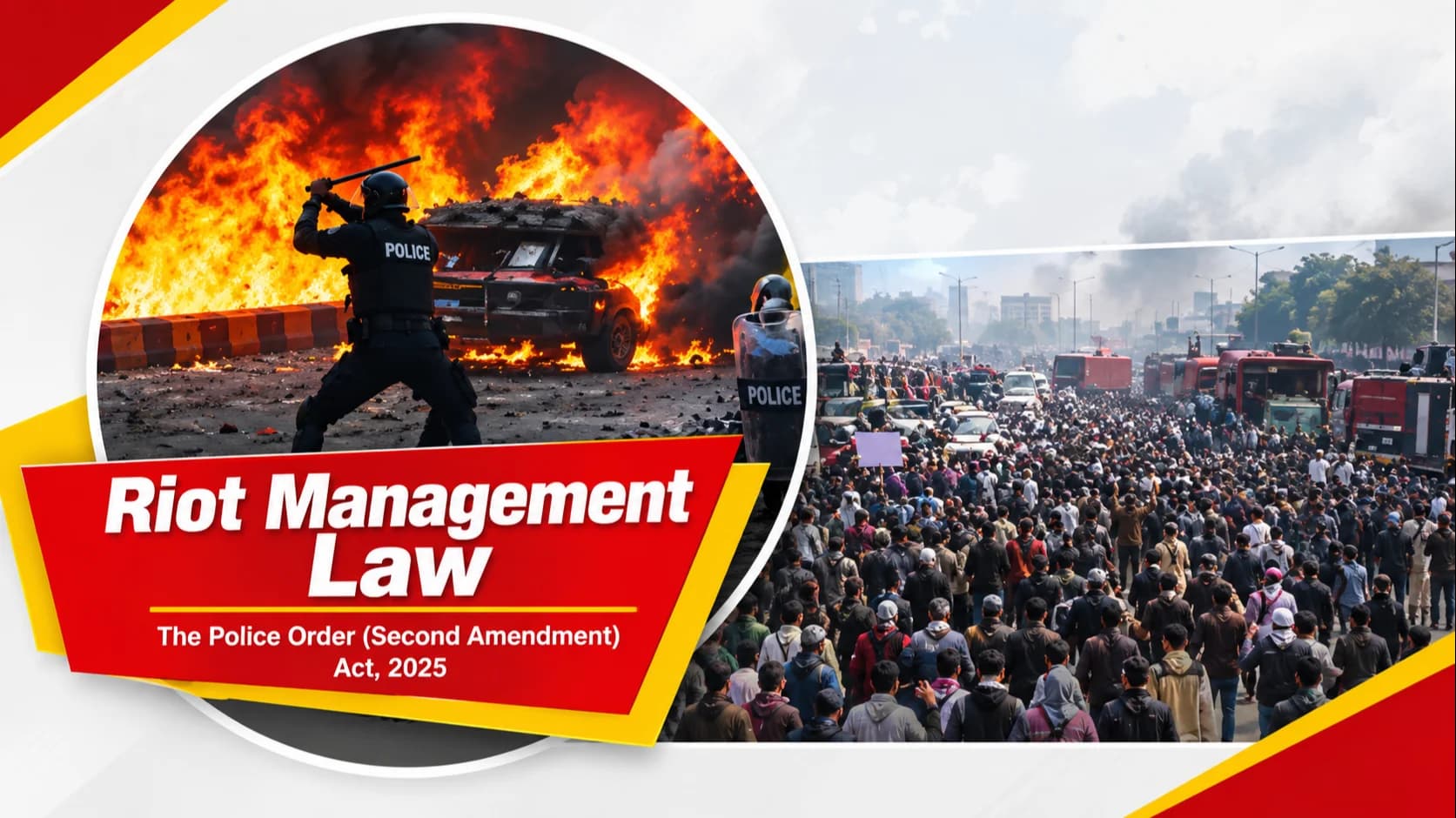
Pakistan, a country of over 250 million people, with its significant geostrategic location, is no exception to this structural architecture of modern states. Article 4 of the Constitution of Pakistan requires everything done by the state to be done in accordance with law. The 'law' on police and policing, however, remains archaic and does not respond adequately to the police and policing requirements. Besides, imperatives of crime control are often confounded with those of public order: while crime control requires better prevention and detection of crime, public order requires dealing with riots and social contestation, which germinate politically. The Police Order, 2002, which is applicable to the Punjab, has been amended through the Police Order (Second Amendment) Act, 2025 (notified on 5th January, 2026), to address the legal gaps in the law of public order and riot management. The instant write-up will summarize the latest amendment to the police law.
The Police Order (Second Amendment) Act, 2025, has the following features:
Hitherto, there were administratively established units to deal with anti-riot and public order situations. These units would dissolve as soon as the contestation and protests ended, and often the officers were not sufficiently trained to deal with riots. In fact, primed on the crime-control capacity of the police, these units were manned by officers who had dealt with crime control, though they had no training and equipment to deal with mobs and masses. With the insertion of Article 31-A into the Police Order, 2002, the new law requires the establishment of a dedicated Riot Management Unit (RMU), which has to be headed by an Additional Inspector General of Police (a BS-21 officer of the Police Service of Pakistan). A provincial headquarters of the RMU has been established and specialized equipment for anti-riot is being procured, and specialized training to deal with mobs and riots is being imparted. In 2016, a similar effort was made in the Punjab, but as the law was not amended, the earlier anti-riot units did not sustain. It is also to be noted that the RMUs are more relevant to urban policing, as modern social contestation has often been seen in big cities; therefore, the placement of the RMUs will largely be in the urban centres. The law requires the RMUs to assist the heads of the district police, implying that the district police will requisition an RMU as per their requirements.
The processes of anti-rioting are being regulated by the Code of Criminal Procedure, 1898, read with Rule 14.56 of the Police Rules, which requires that the crowd be declared unlawful and ample warning be administered before the use of force by police under the watch of an executive magistrate. As the office of the executive magistracy was completely abolished in 2001 due to the constitutional dictates of separating the executive from the judiciary under Article 175 of the Constitution and due to the introduction of the local government system by Musharraf's government, there was an administrative gap about the presence of an executive magistrate at the scene of the riot. The instant law amendment not only fills the gap but also provides for more modern nomenclature to deal with riots. Article 31-B has been added to the Police Order to provide for the procedure to declare a place as a 'Riot Zone'. The District Police Officer (DPO) and the Deputy Commissioner (DC) shall declare a place as 'Riot Zone', and then the DPO shall notify the 'Incident Commander', who shall not be an officer less than the Station House Officer (SHO). With this clarity, the same requirements of administering a warning before use of force by police under Rule 14.56 shall get triggered.
Article 31-C has been added to the Police Order, 2002, which enables the integration of processes of the RMU with the technology apparatus of the Punjab Safe Cities Authority (PSCA) established under the Punjab Safe Cities Authority Act, 2016. The use of technology for the prevention of riots has been quite frequent in many countries. It helps in predicting riot possibilities by monitoring open-source intelligence and by surveilling the social media trends and communications. It also helps in prosecution when the videos and photographs of the rioters are zoomed in and forensically processed for presentation in criminal trials. The law also provides for legal cover for the admissibility of video evidence gathered from PSCA for criminal trial purposes.
The police officers injured or killed during riots are compensated by the government through special compensation and 'shuhada' (martyrs) packages, but there was nothing in the law for civilian victims of the riots – there is a law for civilian victims of the terrorism incidents, though. Article 128 has been added to the Police Order, 2002, to provide for compensation to be paid to innocent civilian victims. The trial court, at the time of announcing judgement, may order the convicts of riots to pay compensation to the civilian victims.
While the rioting and the use of force against public servants were offences for a long time, the criminalization of attacks on law enforcement agencies was long overdue. By introducing Article 154-A to the Police Order, 2002, the acts of vandalism by rioters against law enforcement and private people have been criminalized with punishment of imprisonment up to ten years and a fine.
Article 154-A of the Police Order, 2002, also requires that the trial court must hear anti-riot cases on a day-to-day basis. It must complete the trial in thirty days and should not grant more than two adjournments. The non-implementation of this provision may be reported to the Chief Justice of the Lahore High Court. Likewise, a new article, 154-B, of the Police Order, 2002, requires that no property in the name of a convicted rioter be transferred during the pendency of the trial; if it is transferred, it has to be treated as null and void.
The police and policing laws are part of the criminal law and criminal procedure. The recent amendments to the traffic laws in the Punjab before enforcement action have vouched for the case of law reform before any executive actions. The anti-riot law was long overdue and has tried to cover legal ground for some fundamental areas of law enforcement on the public order side. It is hoped that other provinces will also try to provide a better legal framework for public order and anti-riot management, especially linking the technology to public order management. The initiative is likely to bolster the internal security of the country.
The author is an independent researcher and has done his BCL from the University of Oxford. Email: kamranadilpsp@gmail.com
Topics
The author is an independent researcher and has done his BCL from the University of Oxford.